Being aware of your state throughout the day
A practical approach to noticing your energy, attention, and pace from morning to evening — without adding complexity to your routine.
A practical approach to noticing your energy, attention, and pace from morning to evening — without adding complexity to your routine.

Take a moment to notice your baseline before the day's tasks begin.
A brief stop to observe how your attention and pace have shifted.
Reflect on what you noticed and carry useful observations forward.
These are common everyday signals that people choose to observe as part of a personal awareness practice. This is general lifestyle information, not clinical guidance.
Some people find it useful to notice whether their breathing feels shallow or steady during busy periods.
Awareness of how you are sitting or standing can be a simple cue to pause and adjust.
Noticing when small choices feel slower than usual can prompt a short break before continuing.
Observing how you phrase messages or respond in conversation is a common self-reflection practice.
Many people find that short, timed pauses help them stay oriented. The following is one example of how a structured day might look — adapt it to your own schedule.
Before tasks begin, note one thing you want to stay aware of during the day.
Pause briefly to check in with how you are feeling and whether your pace still fits your plan.
Write down one observation from the day that you would like to remember tomorrow.
These are examples of small, repeatable actions that some people include in their daily routine as part of a personal awareness practice. Individual experiences vary.
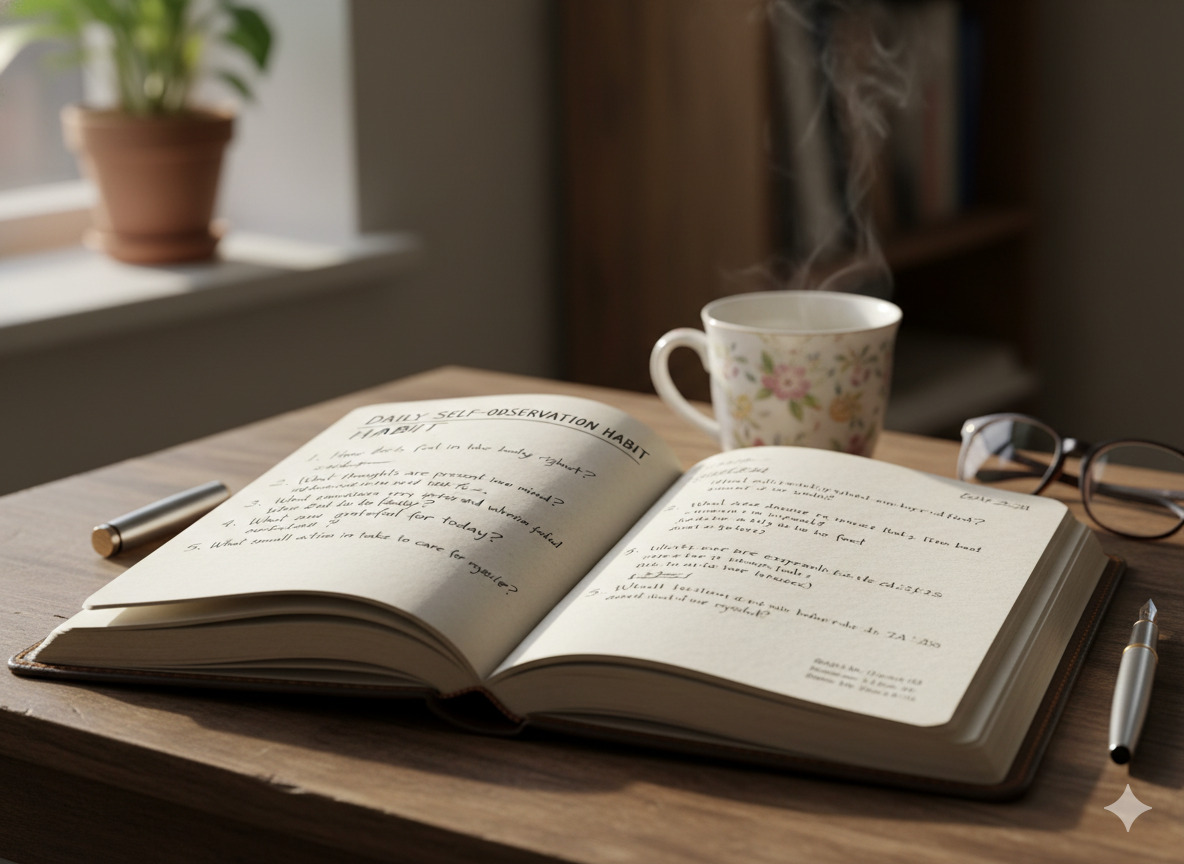

Simple questions to ask yourself at different points in the day.
Ideas for using natural breaks between tasks as brief awareness pauses.
General notes on how surroundings can influence your sense of focus.
A lightweight framework for closing the day with a short written note.
The following are individual observations shared voluntarily. Results and experiences differ from person to person. This content does not constitute an endorsement of any health outcome.
"I started keeping a short daily note and found it easier to spot when I needed a break during the workday."
"The midday pause idea was something I had not tried before. It became a small habit I now keep on most days."
"Reading through the prompts gave me a starting point for a reflection habit I had been meaning to build."
Most of the practices described here take under two minutes. You decide how much time to spend.
No. A notebook or a simple notes app is sufficient. This website does not sell products or services.
The practices described are designed to be brief and flexible. How you apply them is entirely up to you.
No. This website provides general lifestyle information only. Please consult a qualified professional for any personal health questions.
Engene 3, 3015 Drammen, Norway
Phone: +4746885099
Email: info@exchangegoldappr.world
Use the form below to send a general enquiry. We aim to respond within a few business days.
This website provides general lifestyle information only and does not constitute professional, medical, or therapeutic advice. Content is intended for informational purposes and should not be used as a substitute for guidance from a qualified professional. Individual experiences vary. No outcomes are implied or guaranteed.